

Consult

Consult

AI Service
I. Customer Background & Pain Points: Operation and Maintenance Dilemma of Remote Pumping Stations
Project Background
A water group in a city of Guangxi is responsible for tap water supply and sewage lifting across the city and its affiliated towns. It has 37 secondary pressurized pump stations and 12 sewage lifting pump stations under its jurisdiction. These stations are located in urban-rural fringe areas, riverbanks or basements of old residential communities, representing a typical process industrial scenario characterized by scattered sites, wide coverage and harsh environments.
Core Pain Points
1.High operation and maintenance costs
The nearest pump station is 15 kilometers away from the management center, and the most remote mountain station takes over 1 hour by car. The group employs a full-time inspection team, with a full regional inspection cycle of 3 days, resulting in huge expenses on fuel, vehicle depreciation and labor. In addition, underground operations at night or during rainstorms pose significant safety risks.
2.Data silos and chaotic communication protocols
The pump stations were constructed over a long period, equipped with a variety of PLC brands including Siemens S7-200, Mitsubishi FX Series, Omron CP1H and some domestic MODBUS instruments. Due to incompatible protocols, the central control room can only access partial "isolated data" and cannot form a unified scheduling view.
3.Data black holes caused by network disconnection
Most rural pump stations lack fixed broadband resources and only rely on old 2G/3G DTU transparent transmission with unstable signals. Key data such as pressure and liquid level will be lost during network fluctuations. Once, a sewage tank overflow due to interrupted data transmission was not detected by dispatchers, causing river pollution and environmental penalties for the group.
4.Delayed emergency response
In case of water pump failures, sudden pipeline pressure drops or ultra-high liquid levels, manual on-site operation by inspectors is required, which easily leads to pipe bursts or motor dry burning accidents.
II. Solution: AMSAMOTION PG600S "Cloud-Edge-Device" Integrated Architecture
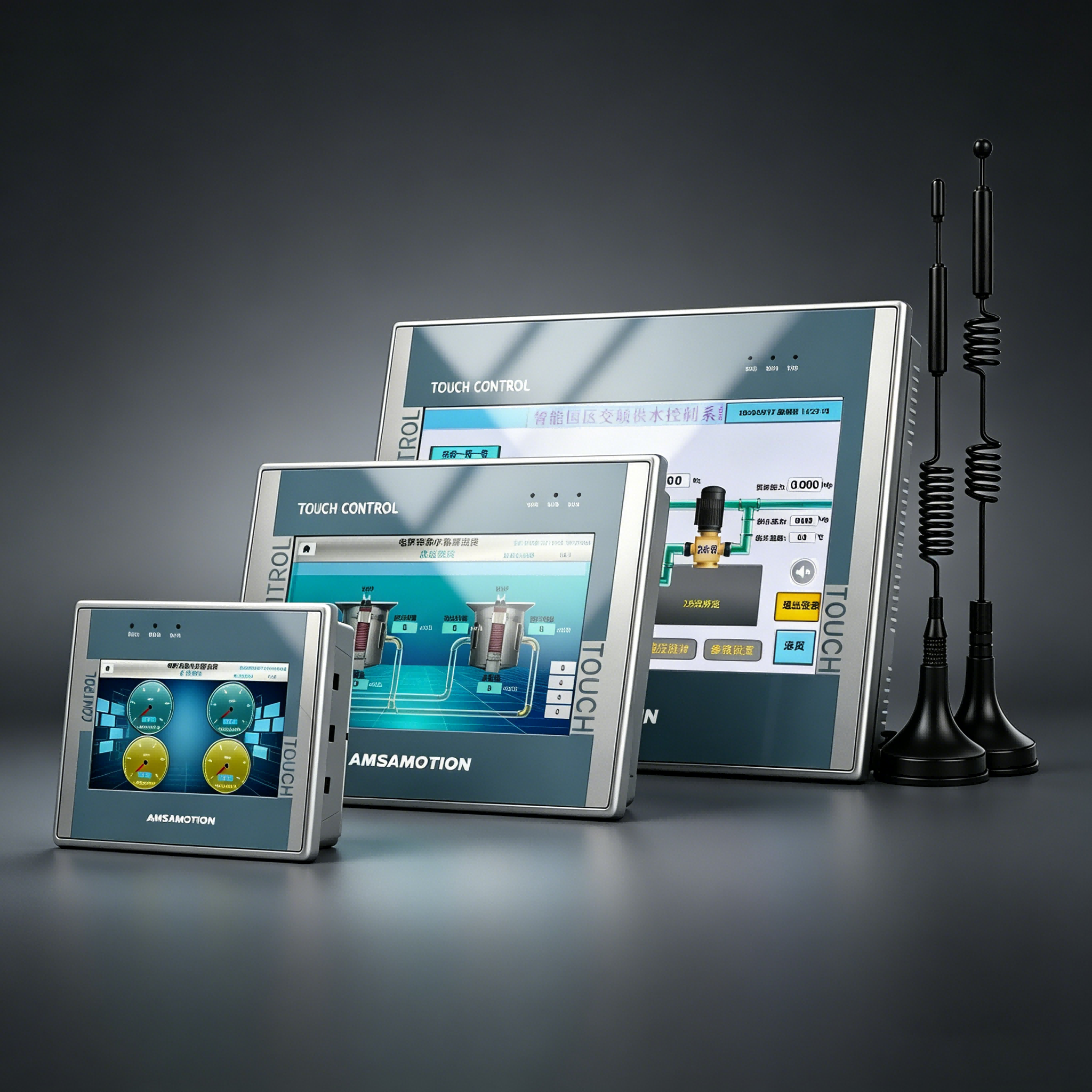
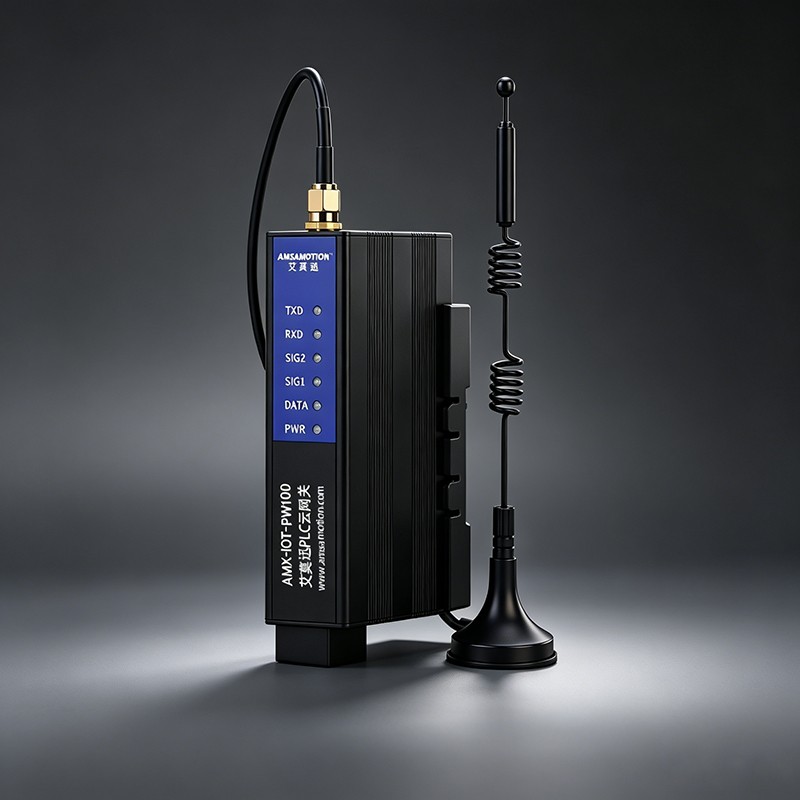
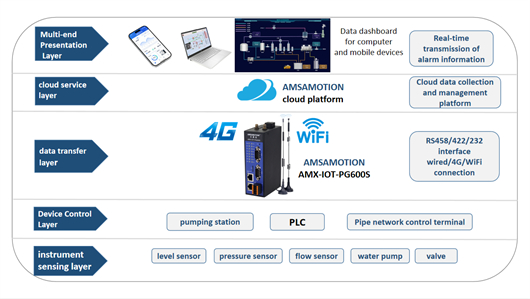
To address the above issues, the water group decided to build an intelligent pump station remote operation and maintenance system with AMSAMOTION AMX-IOT-PG600S industrial IoT cloud gateway, without replacing existing PLCs and instruments.
The system architecture is as follows:
III. Specific Application Scenarios: Whole-Process Unmanned Closed-Loop Control
1.One gateway manages multi-brand devices
On-site devices include Siemens PLCs and MODBUS instruments with incompatible protocols. PG600S gateway realizes parallel dual-drive data collection and unified conversion to cloud format. A single device eliminates data silos without replacing old hardware.
2.Data remains intact even in mountainous areas with network outages
When 4G signal is interrupted, the gateway automatically stores data such as flow, pressure and current in the local SD card. Data will be automatically retransmitted to the cloud after network recovery. The background historical curve is complete without breakpoints, meeting the regulatory requirements for data continuity.
3.Mobile remote emergency stop to eliminate risks
At 3 a.m., a mini-program popped up an alarm: "Sudden drop in outlet pressure, suspected pipe burst". After confirming abnormal liquid level on the mobile cloud configuration screen, the dispatcher remotely shut down the water pump valve 3 kilometers away with one click, taking only 2 minutes to avoid massive water loss and road collapse.
4.One-click report export for environmental protection inspection
When the inspection team requested six months of operation records, operation and maintenance personnel directly exported timestamped historical reports on the cloud platform. Liquid level peaks and pump operating hours were clearly displayed, proving compliant operation with real data and eliminating the trouble of checking paper ledgers.
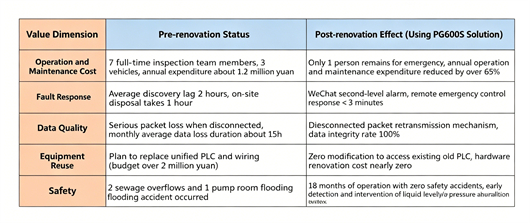
IV. Solution Value: Visible Cost Reduction & Invisible Safety Assurance
V. Conclusion
By deploying AMSAMOTION PG600S industrial cloud gateway, the water group has completed the digital transformation of all pump stations with extremely low hardware investment and short construction period. The project has not only achieved the expected goals of unattended operation and remote control, but also laid a solid big data foundation for the group's energy-saving scheduling and predictive equipment maintenance through reliable data links.