

Consult

Consult

AI Service
The problem of multi-channel instrument data acquisition and protocol conversion is solved in this way
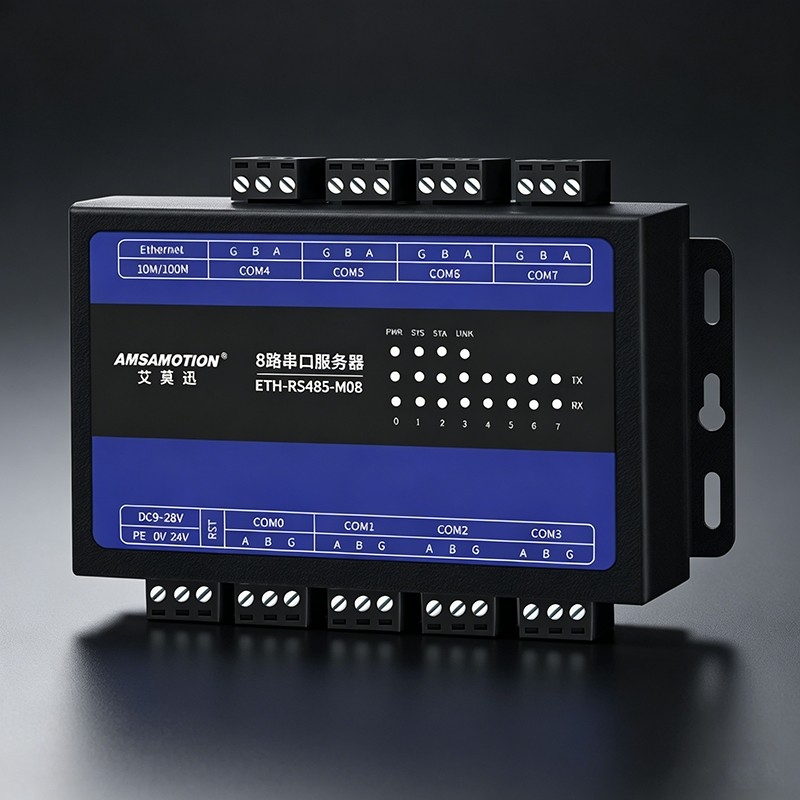
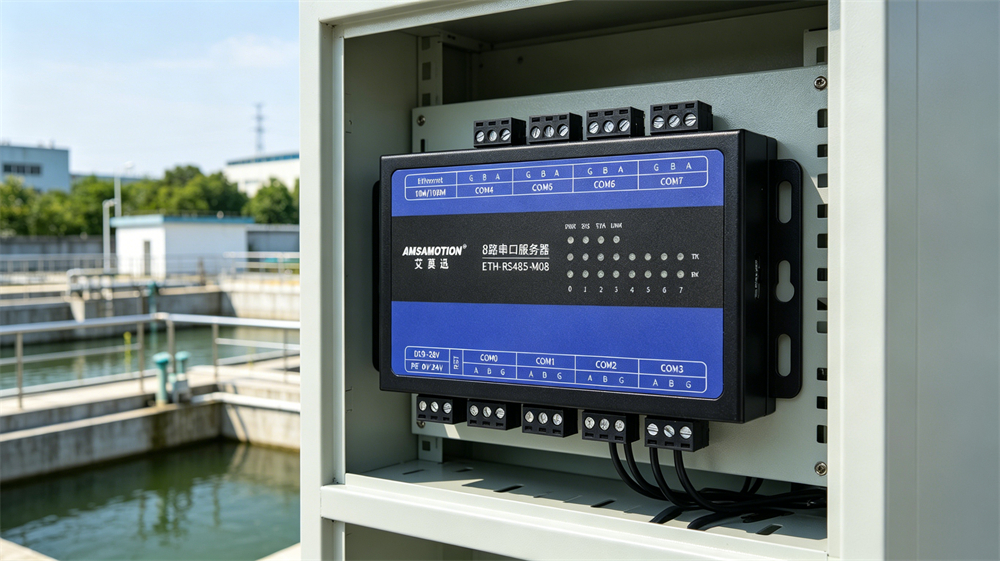
Core equipment: ETH-RS485-M08
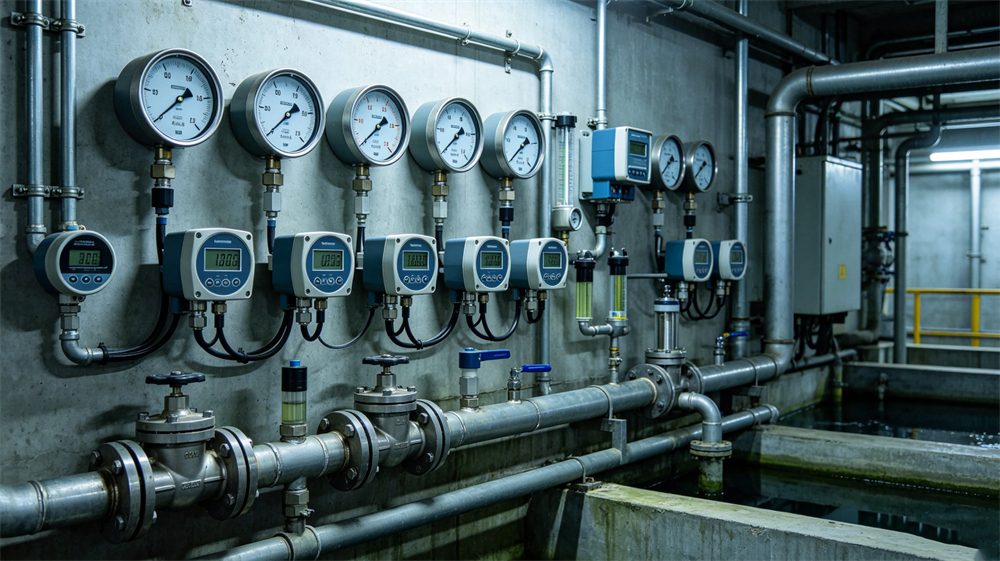
RS485 instrument data collection is common in industrial automation, energy monitoring, sewage treatment and other scenarios. Whether it's temperature and humidity sensors in the factory workshop, pressure sensors, or various instruments in the distribution room, most of them use RS485 serial port to transmit data. But many industrial control personnel have encountered problems such as multiple serial port instruments, slow data collection, inability to view remotely, and lagging and packet loss when collecting data from multiple instruments simultaneously.
Today we will talk about how to use a device to cleanly collect data from multiple instruments.
1、 Industry pain points:
Those who have done on-site debugging understand that multi-channel RS485 instrument collection has a particularly high stepping rate, and the pain points are all real problems on site:
1. Multiple instruments, messy wiring, and easy to malfunction
A workshop may have as few as ten or as many as dozens of RS485 instruments (such as electricity meters, sensors, and flow meters). Traditional solutions require a large number of RS485 buses, which can cause signal attenuation when the line length exceeds 50 meters. This results in strong electromagnetic interference on site, frequent data garbling, and collection failures.
2. Too many bus connections make communication competition a common occurrence.
Modbus RTU uses RS485, which is a polling mechanism - the host asks one by one and the slave answers one by one. The response time of one instrument may only be 30ms, but after hanging 30 instruments, it takes more than 900ms after one round of inspection. If we add a few old instruments with slow response, the cycle will be extended to just over 2 seconds. I can't handle scenarios with high real-time requirements at all.
3. Bus malfunction triggers the entire body.
All devices on an RS485 bus are connected in series, and if any connector in the middle is loose or the cable is damaged, the data of the entire bus will be lost. On site investigation, you need to measure node by node.
4. The protocol is not interoperable, and the data cannot be transmitted or viewed
The vast majority of RS485 instruments use Modbus RTU protocol, but factory PLCs, upper computers, and cloud platforms all use Modbus TCP Ethernet protocol, and serial and network ports are completely incompatible. Instrument data cannot be uploaded to the system, let alone remote monitoring.
5. Insufficient serial port resources between the upper computer and PLC.
Nowadays, PLC serial ports are becoming increasingly scarce, and many new PLCs simply have one or two serial ports. The upper computer is no exception, the physical serial port on the industrial control computer is no longer sufficient. We need to find a way to aggregate dozens of serial port data onto one Ethernet cable.
These pain points are not isolated cases, but common challenges faced by many small and medium-sized enterprises: they want to do digital and remote monitoring, but are stuck in the collection of multiple serial port instruments, and cannot be implemented for a long time.
2、 Solution approach:
In fact, the core solution is in one sentence: choose a serial port server that supports multiple channels and has Modbus protocol conversion, connect serial port instruments in batches, and achieve parallel collection and protocol interoperability of multiple channels.
One AMSAMOTION ETH-RS485-M08 serial port server can handle it: integrating 8 independent RS485 serial ports, each of which can be independently configured, supporting Modbus TCP ↔ RTU protocol bidirectional conversion, with built-in parallel processing capability, perfectly adapts to multi-channel instrument acquisition scenarios.
In this way, each group of buses runs independently and does not interfere with each other. If there is a problem on one route, it will only affect those few instruments, and the other routes will continue to run.
3、 Working principle:
The principle is not complicated at all, in layman's terms it is "translator+multi-channel transfer station":
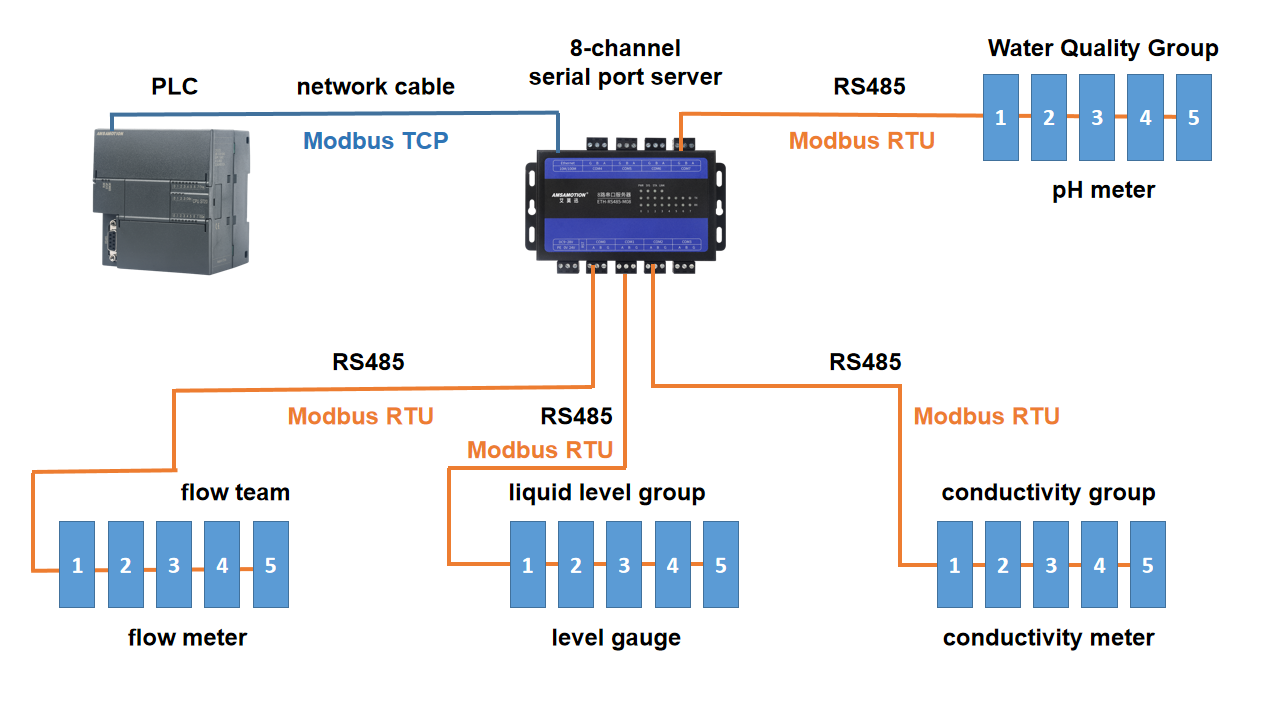
1. Protocol translation: Each RS485 serial port is connected to one Modbus RTU instrument. The upper computer sends Modbus TCP messages (via Ethernet), which are automatically translated into Modbus RTU messages (via RS485) by the serial server and sent to the on-site instrument. The RTU reply of the instrument is then translated back to TCP format by the serial server and transmitted back to the upper computer. The entire process is transparent to the upper computer - it thinks it is directly connected to the serial device.
2. Multi channel parallel transfer: One device has 8 independent RS485 interfaces, each of which can be independently configured with parameters. Equivalent to replacing 8 single serial port servers with one device. 8 channels work simultaneously without interfering with each other. Each channel comes with a 1024Byte cache for parallel processing without buffering or congestion. The data is stably uploaded to the Ethernet and then transmitted to the PLC and upper computer.
Simply put, a serial server is a "networking bridge" for multiple instruments, a "protocol translator", and a "parallel processor", which solves the three major problems of wiring, protocol, and parallelism in one step.
4、 How to do the actual deployment?
For example, a sewage treatment plant has over 20 instruments on site, including pH meters, dissolved oxygen meters, flow meters, liquid level meters, conductivity meters, etc. The upper computer is located in the central control room, more than 200 meters away from the on-site instruments.
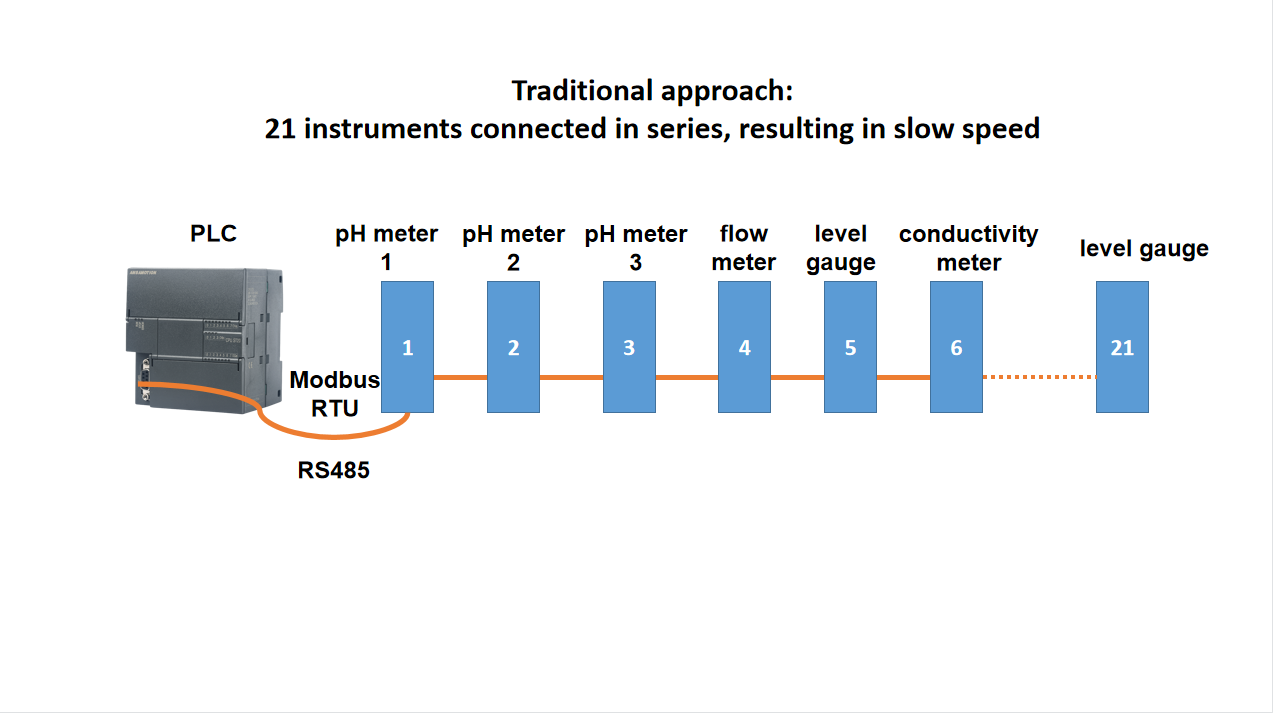
Traditional practice: More than 20 instruments are all connected to an RS485 bus, with a bus length exceeding 500 meters and a relay added in the middle. Communication is often unstable, occasionally dropping a few points, and troubleshooting takes half a day.
New plan: Install an RS485-ETH-M04 (4-channel RS485 to Ethernet) on site and divide the instruments into 4 groups: 6 for water quality, 5 for flow, 5 for liquid level, and 4 for power. Each channel is independently configured and connected back to the control room switch with one Ethernet cable. If there are more than 16 instruments, they can be directly replaced with ETH-RS485-M08 (8-channel version), with enough margin.
This deployment has several obvious benefits: the length of each bus is controlled within 150 meters, and the signal quality is good; A malfunction in one instrument will not affect other channels; The upper computer collects data uniformly through Ethernet, eliminating the need to worry about insufficient serial ports; To add instruments in the future, simply plug them into the vacant position of the corresponding circuit.
5、 Landing case:
Case 1: Centralized collection of multiple instruments in a chemical plant
There are 48 on-site instruments (temperature, pressure, flow, liquid level) in the reactor workshop of a certain fine chemical enterprise that need to be connected to the DCS system. The original plan used two RS485 buses, with 24 units per bus, and communication timeouts often occurred. Later, two ETH-RS485-M08 were used, each with 8 channels and 3 instruments mounted on each channel. After the renovation, the inspection cycle was reduced from 1.8 seconds to 300ms, and the communication failure rate was reduced by more than 90%.
Case 2: Remote Meter Reading of Multi functional Electric Meter in Distribution Room
There are 10 distribution rooms in a certain park, each with 8 RS485 multifunctional electricity meters, which are connected using a Wi Fi serial server (RS232/485-WIFI M01) that supports MQTT protocol. Not only can the RTU data of the electricity meter be converted to TCP, but it can also be uploaded to the energy management cloud platform for remote meter reading, energy consumption statistics, and fault warning, without having to go to the site, and the operation and maintenance efficiency can be improved by 90%.
Case 3: Intelligent Building Energy Consumption Monitoring
A certain office building has 32 RS485 electricity meters, water meters, and air conditioning controllers distributed on each floor. Four RS485-ETH-M04 networks are used to collect energy consumption data in parallel and transmit it to the building's automatic control system via TCP. Remote centralized control reduces energy consumption by 15% and significantly lowers operation and maintenance costs.
Case 4: Smart Agriculture Greenhouse
The multi span greenhouse of a certain agricultural technology company covers an area of over 10000 square meters and has deployed more than 100 sensor nodes (air temperature and humidity, soil temperature and humidity, light, CO2 concentration). The cost of wired wiring is too high, so we ultimately chose a wireless serial port to WIFI product (RS232/485-WIFI M01). RS485 is connected to local sensors, and WIFI sends data back to the control room. At the same time, it also utilizes its MQTT function, which directly pushes data to the Alibaba Cloud IoT platform for real-time viewing through a mobile app.
5、 Actual value:
Using a multi-channel serial port server to solve the problem of instrument acquisition has achieved tangible results:
1. Cost reduction and efficiency improvement: One device replaces multiple single channel servers, reducing the occupation of power, network cables, and switch ports;
2. Data stability: Multi channel parallel processing, no lag or packet loss, doubled data refresh rate, bid farewell to timeouts;
3. Isolation of each channel: Multiple channels communicate independently, and a fault in one channel does not affect the overall system, greatly improving system reliability;
4. Flexible expansion: 8/4/1 serial ports can be matched as needed, and additional instruments can be directly expanded without changing devices;
VI. Summary
The difficulty in collecting multi-channel instrument data is to think clearly about the architecture at the beginning of the project - how to group the bus, how to select equipment, and how to plan the network.
There are multiple models of serial servers, ranging from 1 channel, 4 channels to 8 channels, from wired to WIFI, from universal protocol conversion to cloud platform direct connection, basically covering common instrument acquisition scenarios in industrial sites. When selecting, remember one principle: do not use serial ports for parallel devices, do not hang all devices that can be grouped, and try not to use serial ports for devices that can use Ethernet cables.